
For jury members, partners and anyone checking
Preparation you can check.
Doctors and dentists who already live in the Netherlands, at work sooner and better prepared. We bring clinical knowledge, the Dutch guideline and the consultation in Dutch together on one candidate, and every explanation can be traced back to the source it rests on. We do not add exam places or training posts; we help make sure the places that exist are used well.
We do not ask you to believe us. We ask you to check us.
Our listing in the Dutch innovation database: Mentora Medic on Zorginnovatie.nl ↗
The gap we work on
Without other policy, the staff shortage in care and welfare rises to almost 301,000 in 2035 (labour-market forecast, ABF Research for VWS, December 2025). Meanwhile doctors and dentists who trained outside the EEA sit at home. Their medical knowledge is not the problem. The problem is the transition to Dutch practice: which guideline applies here, where the responsibility of the huisarts ends, and how the consultation runs in Dutch. On top of that the professional exam is scarce: 74 places a year for doctors, in three sittings (CIBG, September 2026; for 2027 the CIBG mentions 120). There is no resit: after an insufficient result the committee reviews the file more extensively, an advisory interview follows, and additional training may be advised. According to the UAF, the wait for the exam has risen to about two years. And the exam will cost more: under the tariff proposal now in consultation, the fee rises from €1,700 to €5,371.50 on 1 March 2027.
From scattered preparation to one measurable route
MentoraMedic works on one concrete part of the labour-market problem: speeding up and better guiding the route from international care professional to a qualified professional who stays employable. Today a candidate puts that route together from separate courses, sites and exams. We bring it into one route in which every step inside the platform is measured.
- International care professional in the Netherlandsdoctor or dentist with a diploma from outside the EEA
- MentoraMedicLanguage up to B2+ with medical Dutch · clinical knowledge with the Dutch guideline · consultation practice with an AI patient · preparation for the BI-toetswe measure: progress, level, exam readiness
- BI-toets and BIG registrationreported by the candidate
- At work in caretogether with the employer
- Employable for the long termwith the employer; a goal, not yet a result
The question bank, the AI patient and the language course are the mechanism, not the innovation itself. What happens after the platform, registration, work and retention, we follow together with the candidate and the employer; those figures are not ours to claim. The same route fits nurses, where the shortages up to 2035 are largest; their language part up to B1 is already in the platform, a question bank of their own follows in 2028.
One real question from the bank
Not a mock-up: this is question 2260 as a candidate sees it, with the answer he picked wrong, the explanation, and the source underneath. The link goes to the guideline itself.
Een 6-jarig meisje met bekend astma wordt op het spreekuur gepresenteerd wegens een milde exacerbatie na een verkoudheid. Zij hoest veel en piept bij inspanning, maar praat in volledige zinnen en heeft een saturatie van 96%. De huisarts besluit een stootkuur orale prednisolon voor te schrijven. Volgens de NHG-Standaard ‘Astma bij kinderen’ is de aanbevolen dosering 1 tot 2 mg per kg per dag, gedurende 3 tot 5 dagen (maximaal 40 mg per dag).
Deze stelling is op twee gronden onjuist. Ten eerste is er sprake van een milde exacerbatie (het kind spreekt in volledige zinnen, saturatie 96%), waarbij een systemische stootkuur volgens de NHG-Standaard niet geïndiceerd is: het beleid is intensiveren van SABA via voorzetkamer. Ten tweede adviseert de standaard bij een wél geïndiceerde stootkuur bij kinderen strikt 3 dagen (1-2 mg/kg/dag, max 40 mg), in tegenstelling tot de 3 tot 5 dagen bij volwassenen.
Een scholengemeenschap ontwikkelt een mondgezondheidsscreening voor 6- tot 12-jarigen. Het budget is beperkt en moet kosteneffectief zijn: vroege detectie van cariës en orthodontische problemen, met verwijscriteria. Welk screeningmodel biedt de beste kosteneffectiviteit voor deze schoolpopulatie?
Voor het kosteneffectief opsporen van cariës en orthodontische afwijkingen in een schoolpopulatie biedt tweejaarlijkse screening door getrainde mondhygiënisten de beste verhouding tussen nauwkeurigheid en kosten. Mondhygiënisten voeren dit onderzoek betrouwbaar uit tegen een gunstiger tarief dan tandartsen. Jaarlijks onderzoek levert nauwelijks extra opbrengst tegen dubbele kosten.
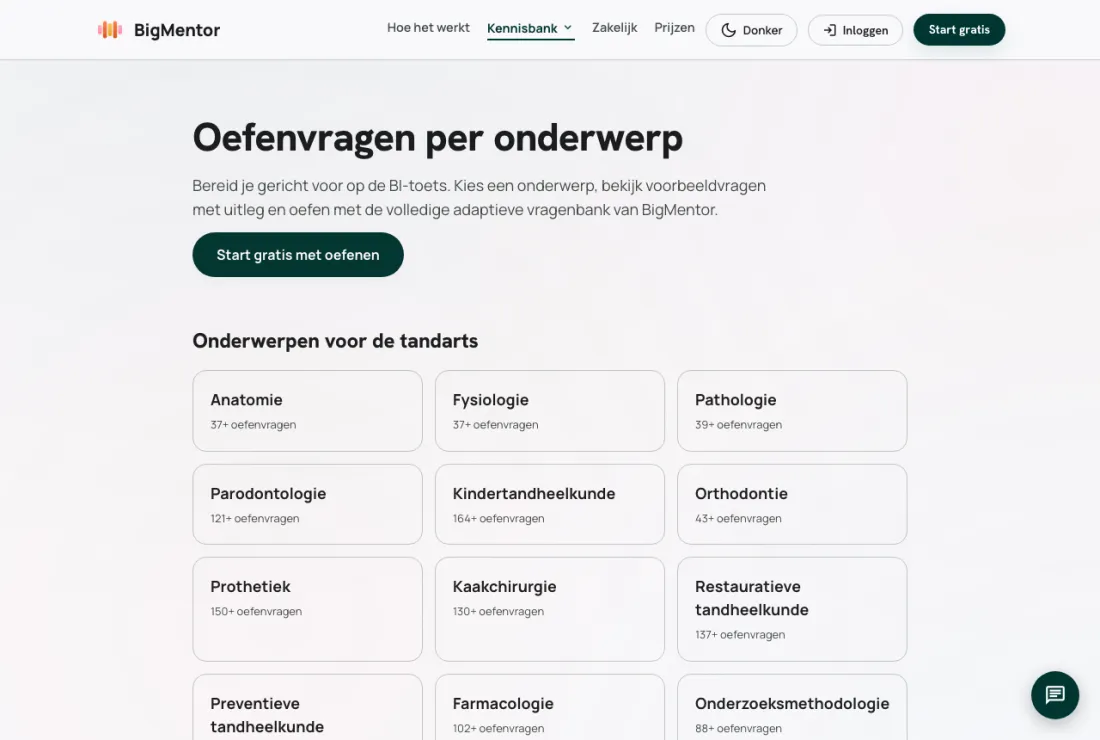
Pick an answer, right or wrong: the explanation opens, and under it stands the source. Two of the 4.137 questions in the bank.
And we watch whether those sources still hold
A guideline changes and a question bank goes stale in silence: the NHG revises a standard, the question still looks the same, and nobody notices that the explanation underneath has fallen behind. Every Monday we walk past all 348 sources the explanations rest on. Questions whose source was revised after a human last looked at them are flagged for review.
348 sources watched 3 no longer reachable last checked: 2026-10-19
Check it in three steps
1. Pick an answer to question 2260 above: that is a real question from the bank, with the source under the explanation. 2. Create a free account on bigmentor.nl, no payment details needed, and answer a few questions. 3. Under every explanation in the platform you find the theory card and the source, with name, link and revision date; the link goes to the guideline itself, not to a page of ours.
What is new about it
Not the technology, but the accountability. Every question bank gives an explanation after a wrong answer. Being able to check what that explanation rests on is rare.
See it yourself, with a free account
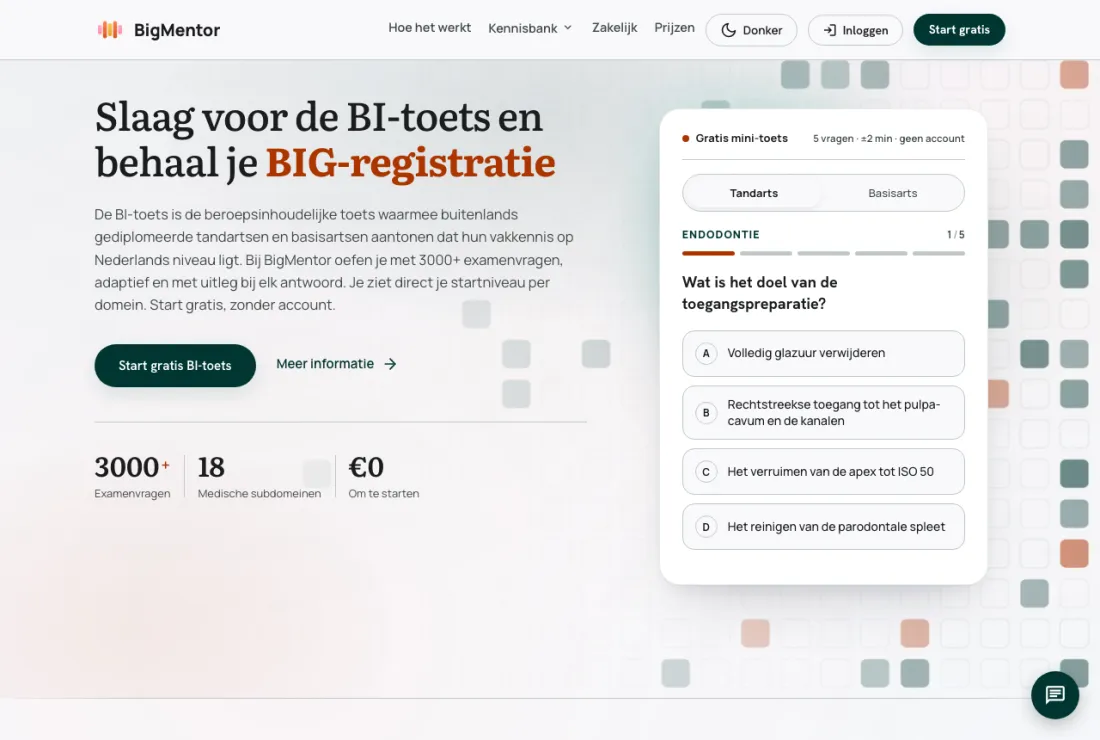
The exam preparation runs on our own platform, BigMentor. A free account is enough to see it: under every explanation the theory card and the source, with name, link and revision date. That is the innovation in one screen. The short mini test on the home page is only a first introduction. The language course lives at taal.mentoramedic.eu, where the first unit is open as well.
Three names, one route: MentoraMedic is the route and the guidance, BigMentor is the exam preparation, the MentoraMedic Academie is the language course.
Practising the consultation
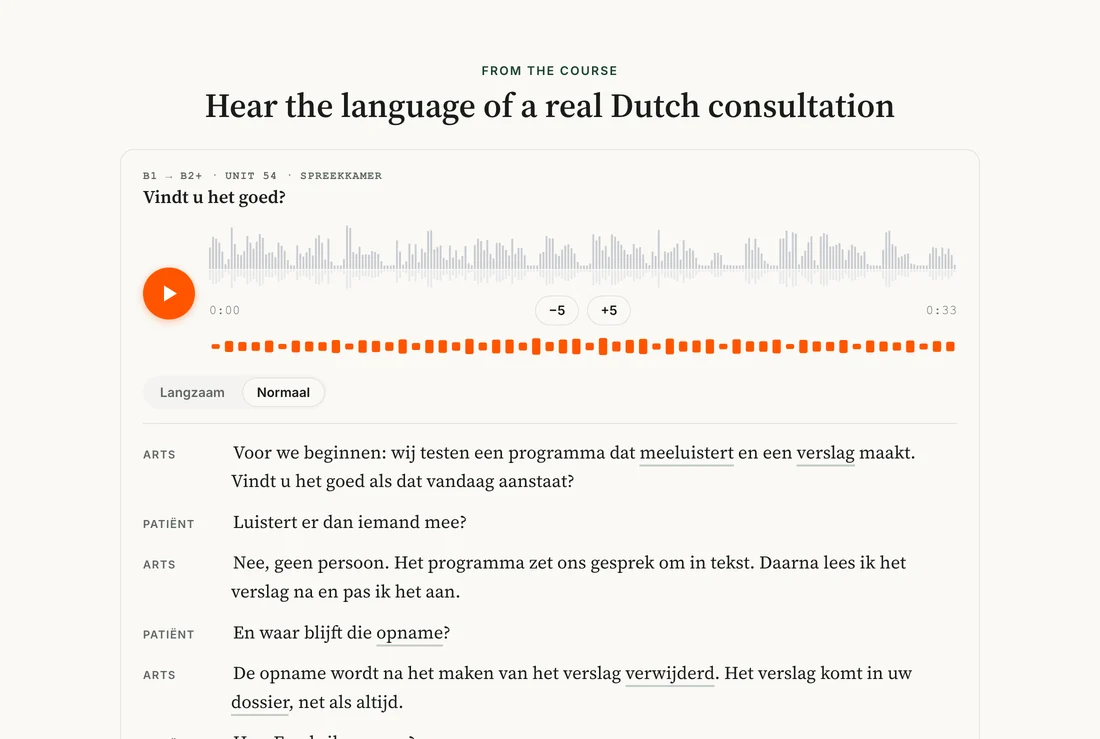
In the skills test the candidate talks to a simulated patient. Knowing the guideline is not enough there: the consultation has to run the Dutch way. In our consultation practice the candidate types his own questions, with no options to choose from, to an AI patient who only reveals what is asked. Afterwards comes a review: which parts of the history were covered, whether a working diagnosis and a plan were named, and where the Dutch can be clearer.
The review is advice, not an assessment: no score, no pass or fail. The official rubric of the skills test is not public, and we do not pretend to imitate it.
Who pays
For an employer who hires a status holder, the SOWIS scheme offered €3,000 per person in 2026 for guidance and professional language at work; our route fits within that amount. Whether the scheme returns in 2027 is not yet known. The digital product scales at almost no extra cost; the guidance is the part that takes people.
What it looks like today
Three screens from the live product, not mock-ups. Everything below is open without an account.
The next step is evidence
We do not want to claim that our preparation works. We want to measure whether it works, and that is a different job than building a platform.
- A small test group of candidates with a confirmed exam date, December 2026 and February 2027.
- Their starting point on record: an intake (profession, experience, first attempt or resit) and a first round of 50 questions.
- Learning data from the platform, week by week.
- The actual outcome of the official exam, reported by the candidate.
- A knowledge institution that answers the research question: is learning behaviour related to passing?
Steps one to four are ours and are running. Step five is not: the data is ours, the methodology is not. That is what we are looking for a partner for. What we will measure, against the national figures: the time to the exam, the result at the first attempt, and the time to work.
Where this sits in the route
- 01 Medical Dutch, A0 to B2+ MentoraMedic Academie
- 02 Diploma recognition CIBG & CBGV
- 03 The BI-toets BigMentor
- 04 BIG registration CIBG
- 05 At work employer
Two of the five steps are ours; the other three belong to the CIBG, the CBGV and the employer. We say which is which, so nobody waits for us where we have nothing to do.
Who brings what, and who gains what
The candidate
brings a medical diploma, experience, daily practice
gains one route instead of loose pieces, and a better chance at the first attempt
The employer
brings places for candidates, a job at the end
gains insight into when a candidate is ready, with the candidate's consent; a doctor at work sooner
The municipality
brings status holders with a medical diploma, the civic-integration route
gains work at the right level instead of benefits
Guiding organisations
bring candidates they already guide, and what they see go wrong
gain preparation their candidates can start today
A knowledge institution
brings the research method
gains learning data from a group that is rarely studied
MentoraMedic
brings the platform, the content with sources, the guidance
gains paying partners and evidence of what works
The same on one page: who brings what (PDF, Dutch).
Roadmap
Small steps that each depend on at most one partner. No national rollout on paper before the first pilot has shown what works.
| When | What | Result |
|---|---|---|
| 2026 Q4 | Test group, first exams in December and February | first data on the route from start to exam |
| 2027 H1 | Pilot with one employer or municipality, 5 to 10 candidates | monthly progress report for the organisation, first outcomes |
| 2027 H2 | Pilot report, second and third partner | price and model tested |
| 2028 | Nurses as a second profession, research with a knowledge institution | a second route, independently tested findings |
What we do not claim
We name no pass rate. The platform has been live since June 2026 and our first candidates still have the exam ahead of them; a figure would be invented. Measuring the chance of passing at the first attempt is our first priority as soon as the first group sits the exam. We also do not say that every question has a guideline under it: for legislation, ethics and a large part of dentistry there simply is none, and we do not invent a source where there is none. Those questions are tied to the national Raamplannen instead. The AI patient does not assess and does not replace the skills test. And we do not issue the B2+ language certificate: the candidate obtains it from a provider on the official list.
What we are looking for
An employer or a municipality for a first pilot: a handful of candidates, an evaluation after three months, and together we follow how it goes up to their exam. Organisations that guide foreign-trained doctors, to try it with their candidates. And a native speaker or NT2 teacher to review the language course. The explanatory note to the new tariff regulation points at the future employer itself as the paying party.
And a knowledge institution to research whether our learning data is related to actually passing the official steps. We have the data; the methodology is not ours to supply. Reach us at [email protected].
On one page: MentoraMedic at a glance (PDF, Dutch).